
Maintaining a lush and weed-free St. Augustine grass lawn requires the right combination of nutrients and effective weed control. Selecting the best weed and feed fertilizer tailored for this southern turfgrass can improve its health while combating broadleaf and grassy weeds. This guide highlights some of the top options designed specifically for St. Augustine grass, showcasing key features to assist your choice.
| Product | Brand | Key Features |
|---|---|---|
| Fertilome St. Augustine Weed & Feed 15-0-4 | ferti-lome | Pre- and post-emergent weed control, fertilizer mix ideal for St. Augustine |
| BioAdvanced 3-in-1 Weed and Feed for Southern Lawns | BioAdvanced | Up to 6 months weed prevention, targeted for southern grasses including St. Augustine |
| LESCO St. Augustine Grass Weed and Feed | LESCO | Slow-release fertilizer with penoxsulam, safe for Floratam variety |
| Scotts Turf Builder Lawn Food | Scotts | Improves root strength, suitable for all grass types |
| Scotts Green Max Lawn Food with Iron | Scotts | Dual-action fertilizer with iron for deep greening |
Fertilome St. Augustine Weed & Feed 15-0-4 (12.8 lbs.)

The Fertilome St. Augustine Weed & Feed fertilizer integrates both pre-emergent and post-emergent herbicide action designed specifically for southern lawn grasses, including St. Augustine, Centipede, and Zoysia. Its nutrient formulation is 15-0-4, focusing on nitrogen and potassium to promote healthy lawn growth without a phosphorus component, which suits lawns already rich in soil phosphorus.
This product combats various weed types reliably but is not recommended for Bermuda or northern grass types. Its targeted formula limits weed competition while feeding your grass, making it a solid choice for maintaining weed-free St. Augustine lawns. The granular format allows for easy application and uptake by the turf.
BioAdvanced 3-in-1 Weed and Feed for Southern Lawns, Granules

BioAdvanced’s 3-in-1 Weed and Feed targets southern grasses such as St. Augustine and Bermudagrass with a formula that offers up to 6 months of weed prevention. This product works on major broadleaf weeds like dandelion, dollarweed, and clover, while feeding the grass for a vibrant lawn.
Its longer-lasting protection reduces the frequency of applications, making it practical for homeowners seeking an effective, extended solution. BioAdvanced specifically supports southern lawn health and ensures the grass gets essential nutrients alongside weed control.
LESCO 50 lb. St. Augustine Grass Weed and Feed with Penoxsulam
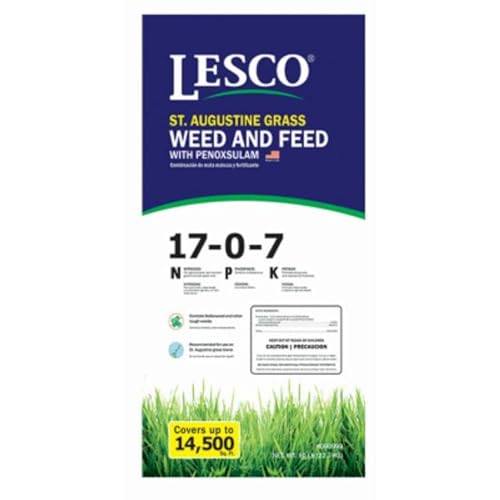
The LESCO St. Augustine Grass Weed and Feed is a professional-grade 17-0-17 fertilizer combined with weed control via penoxsulam. Designed with a slow-release formula, it provides consistent feeding for up to 8 weeks, ensuring steady turf growth and resilience.
This large 50 lb. bulk bag covers about 13,000 square feet and is safe for the Floratam variety of St. Augustine grass. Application should be performed when the turf is wet for optimal adherence and results, which become noticeable within two weeks.
Scotts Turf Builder Lawn Food – Fertilizer for All Grass Types

Scotts Turf Builder Lawn Food is a versatile fertilizer that strengthens lawns of all grass types, including St. Augustine. Its 12.5 lbs. package covers approximately 5,000 square feet and supports deep root growth and improved nutrient absorption.
This product helps the lawn withstand environmental stressors and improves its ability to retain water. It is easy to apply to wet or dry lawns and can be incorporated into any lawn care routine for general turf nourishment.
Scotts Green Max Lawn Food with Iron Supplement

Scotts Green Max Lawn Food combines fertilization with an iron supplement to promote faster greening within three days. Its formula includes 5% iron, a key micronutrient to enhance chlorophyll production and vibrant color in St. Augustine grass.
Suitable for application in spring, summer, and fall, this fertilizer invigorates lawn health while also feeding the grass. The 16.67 lbs. package treats up to 5,000 square feet and supports sustained lawn vitality alongside weed care.
Buying Guide For Weed And Feed Fertilizers For St. Augustine Grass
Key Nutrient Ratios
When selecting a fertilizer, look for nutrient ratios tailored to St. Augustine grass. Commonly, nitrogen (N) is emphasized to boost green growth and vigor, often with potassium (K) to enhance durability. Phosphorus (P) is typically lower or zero since many areas already have sufficient soil phosphorus. A ratio similar to 15-0-4 or 17-0-17 is ideal.
Weed Control Spectrum
Choose products that offer both pre-emergent and post-emergent herbicide activity to cover broadleaf weeds and grassy weeds. Some formulas target specific weeds prevalent in southern lawns, such as dollarweed, clover, and dandelion. Long-lasting protection, like up to six months, reduces the need for frequent applications.
Compatibility With St. Augustine Varieties
Ensure the product is safe for all or your specific St. Augustine types, such as Floratam. Some products specify usage restrictions on certain grass types, so verify this to avoid damaging your lawn.
Application Method and Timing
Granular fertilizers are common and allow easy spreading; some require application on wet grass or watering in. Liquid fertilizers and sprays can provide quicker results or target actively growing weeds. Apply weed and feed products when weeds are actively growing but the lawn isn’t stressed from drought or extreme heat for best efficacy.
Duration of Feeding and Weed Control
Slow-release fertilizers feed over a longer duration (up to 8 weeks), supporting consistent lawn health. Extended weed control (up to 6 months) reduces maintenance frequency. Consider your lawn care schedule when selecting based on these time frames.
Additional Nutrients
Iron supplements in lawn fertilizers can accelerate greening without excessive nitrogen. If your lawn appears pale, consider formulas including iron for enhanced color.
Environmental and Safety Considerations
Look for products with clear application instructions to minimize environmental runoff. Follow all label guidance to protect local waterways and avoid harming desirable plants.